
Types of Clouds
High Clouds | Description |
|
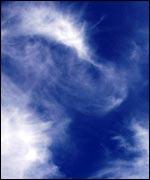
Cirrus | Detached clouds in the form of white delicate filaments or white or mostly white patches or narrow bands; have fibrous (hairlike) appearances or a silky sheen or both. | |
Cirrocumulus | Thin white patch, sheet, or layer of cloud without shading; composed of very small elements in the form of grains, ripples, etc., merged or separate, and more or less regularly arranged. | |
Cirrostratus | Transparent, whitish cloud veil of fibrous or smooth appearance, totally or partly covering the sky, and generally producing halo phenomena. | |
Middle Clouds |
|
|
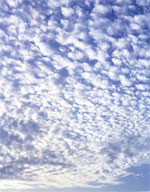
Altocumulus | White or grey (or both white and grey) patch, sheet, or layer of cloud, generally with shading; composed of rounded masses, rolls, etc., which are sometimes partly fibrous or diffuse and which may or may not be merged; regularly arranged small elements. | |
Altostratus | Greyish or bluish cloud sheet or layer of striated, fibrous, or uniform appearance; totally or partly covers the sky; parts thin enough to reveal the sun at least vaguely; does not show halo phenomena. | |
Nimbostratus | Gray cloud layer, often dark; appearance is rendered diffuse by more or less continuously falling rain or snow, which in most cases reaches the ground; thick enough throughout to blot out the sun; low, ragged clouds frequently occur below the layer, with which they may or may not merge. | |
Low Clouds |
|
|
Stratocumulus | Gray or whitish (or both grey and whitish) patch, sheet, or layer of cloud which almost always has dark parts; composed of rounded masses, rolls, etc., which are mostly nonfibrous and which may or may not be merged; regularly arranged small elements. | |
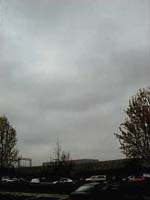
Stratus | Generally grey cloud layer with fairly uniform base; may give drizzle, ice prisms, or snow grains; when sun is visible through the cloud, its outline is clearly discernible; stratus does not produce halo phenomena except possibly at very low temperatures; sometimes stratus appears in the form of ragged patches. | |
Cumulus | Detached clouds, generally dense and with sharp outlines, developing vertically in the form of rising mounds, domes, or towers, of which the bulging upper part often resembles a cauliflower; sunlit parts of these clouds are mostly brilliant white; their base is relatively dark and horizontal; sometimes cumulus is ragged. | |
Cumulonimbus | Heavy and dense cloud, with a considerable vertical extent, in the form of a mountain or huge towers; at least part of its upper portion is usually smooth, or fibrous or striated, and nearly always flattened; this part often spreads out in the shape of an anvil or vast plume; under the base of this cloud, which is often very dark, there are frequently low, ragged clouds either merged with it or not, and precipitation. | |
Document Actions
 Like us on Facebook